

Did Shepherds in Bethlehem Include Females?
Who were the people who kept "watch over their flock by night"?

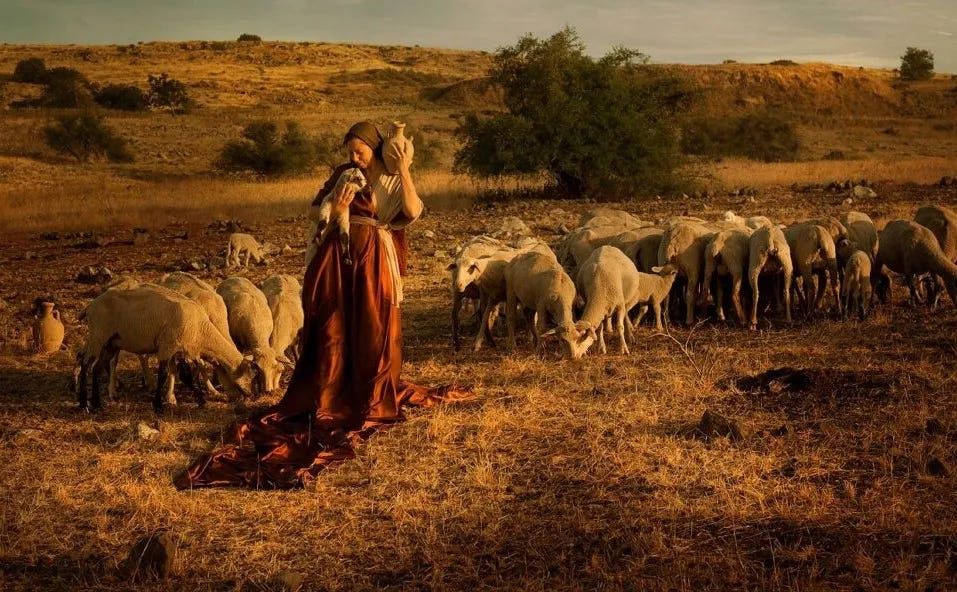
Does your nativity set have any female shepherds? Until two years ago when a friend gifted me with a set that included one, mine didn’t. For the longest time I thought shepherds were only male—an image I doubtless picked up unconsciously from art. Without anything said outright about the sex of the shepherds mentioned in Luke 2, I internalized the idea that “shepherd” was a guy job.
If I saw a Christmas pageant with girls dressed in bathrobes holding shepherds’ crooks, I would tell myself the real nativity story lacked girls. Surely the directors were taking creative license, adding roles to include all the kids in the show.
But now I know those females in bathrobes more closely represented reality than did my misinformed imagination.
My understanding about shepherds shifted when I traveled with my husband, Gary, and our daughter to Kenya’s Rift Valley. Gary serves national leaders in remote areas, providing training and support services as they take the gospel to those least served. (Sometimes they need a motorcycle; sometimes, a portable water filter.) When we accompanied him almost two decades ago, one of his Kenyan ministry partners, Joseph, a Maasai warrior, invited us to visit the dwellings of his family and friends.
The Maasai are pastoral people—shepherds—living in individual huts inside bomas—enclosures made of brambles encircling dwellings made by women out of mud, sticks, grass, and cow dung. (Housebuilding, including roofing, is women’s work.) Inside the perimeter of the boma sits a big livestock pen, also made of brambles.
During the day, usually girls are the ones responsible for shepherding the goats and sheep, sometimes with their mothers or a grandparent, while boys shepherd the larger livestock. If a family has no girls—or not enough girls—the youngest son (or sons) also gets assigned sheep-and-goat duty. The pecking order in their culture is usually men, animals, women, children. In such pastoral settings, livestock are the pantries, 401(k) plans, savings accounts, and Meals on Wheels. Often shepherd-girls lack education because someone must guard the assets, and boys’ educations take priority.
This setup or a similar one has been true for many pastoral peoples across time and geography. Consider that David, son of Jesse, who had multiple brothers—at least three in the army—was the youngest boy and thus the shepherd among Jesse’s eight sons.
The Maasai, like so many Bedouins my husband and I met in Jordan that same year, live—or abide, or dwell—in the field. And that is exactly how Luke describes what the shepherds in Jesus’s birth narrative are doing: they are abiding or dwelling in the field. Not roaming. They live there.
And what are they doing at night? Watching their flock. Singular. And like our Maasai friends, the shepherds to whom the angel choir appeared were probably not a bunch of unrelated guys from different families watching multiple flocks dotting an open hillside.
The highlight of my time with the Maasai on that trip was watching the “Jesus” film with them. We threw a bedsheet over the top of a hut, hooked up a generator, and voila! The best part was hearing their gasps of delight when the angels appeared to shepherds saying, in Naa—their own language— “Fear not! For I bring you good news of great joy for all the people!”
A week later, we moved on to meet members of the Pokot tribe. And along the dirt road far from town, we saw female Pokot shepherds out by themselves herding sheep.
These experiences led me to ask some questions about the biblical text of those living much closer to the world in which Jesus’s birth narrative was set. And here’s what I learned:
Vocational shepherds are not outcasts. They smell a lot like a typical cowboy. Animal pens stink, but humans who keep the animals don’t walk around with dung clinging to themselves if they can help it.
That said, shepherds don’t inhabit halls of power. My shepherd friends were overjoyed that in Jesus’s nativity story, instead of appearing to rulers in palaces or temples, the angels came to those far lower on the rungs of social power. The Maasai shepherds heard in the angels’ proclamation an emphasis on “all the people”—from the highest to the lowest.
Sisters, a mother, and a grandmother or two were probably present when the angels announced their glad tidings.
Later, I followed up with a Maasai brother to ask for more details, and he said in his world, after the animals are in their pens for the night, the whole extended family gathers around the fire to hear and tell stories. When thinking of the angels’ good news, he envisions an extended shepherding family warming themselves around a fire near a pen. We know from John’s Gospel that sheep got gathered into a “sheepfold” (see John 10). More likely, then, the shepherds whom Luke describes were from one extended family with male, female, old, and young sitting around a crackling fire, and someone was in the middle of a story when suddenly….!
So, what are some spiritual ramifications?
We need to read the Bible in community with Christians whose lives are closer to the world of the text than to those of us with central heating and bank accounts with passwords. That means taking the posture of a learner in the presence of those who can see what we cannot.
Representation matters. When I mentioned on Twitter (it was Twitter then) the possibility that females were present at the pronouncement of “good news for all the people,” some responded with tears and joy. For the first time they saw themselves in the story. Yet in a quick search for Christmas Bible art, I found Mary as the only female in any of the multiple scenes. The biggest demographic leaving the church is young females. How can we show women more hospitality in the stories we tell and translations we use?
God loves the lowly and so must we. Although shepherds were not despised nor regarded as the lowest of the low (as they are sometimes described), they acknowledge that neither are they among the rich or powerful. The heavenly choice to make the announcement to those outside of the usual authority structures reveals something about the heart of God and the inclusiveness of the good news. Do we want to be like him?
After my brief visits to shepherding cultures, I started noticing when nativity scenes included a female shepherd or two. (And some old people.) Since females were last at the cross, first at the tomb, and the first to herald the good news that Jesus is alive, it makes perfect sense that females would also have been among the first at the manger.
And what does Luke tell readers these shepherds did? After seeing the swaddled child, they glorified and praised God (Luke 2:20). Like them, let us do the same!
On the “Talking Church” podcast I said a woman’s highest calling is something even greater than motherhood—following Christ. Not controversial, right? Or so I thought. I was paraphrasing the Westminster Larger Catechism (WLC). But apparently while “the chief end of man is to glorify God and enjoy Him forever,” some seem to think the chief end of woman is to glorify her husband and serve her kids. The episode has generated lots of comments and the highest traffic of anything I’ve ever done. I never would have guessed a paraphrase of WLC could get me tagged as a radical feminist!
Last month I presented at an academic conference on Artemis in Ephesus. Dr. Gary Hoag was in the lineup as well. A couple years ago, he and I spoke with Dr. Darrell Bock, host of The Table Podcast, about Ephesus at the time of the earliest Christians. They recently re-released the episode so, you can watch it here: “How Ancient Inscriptions Help Us Understand the Biblical World (Classic)” »
Coming January 1: I was honored to contribute study notes on Song of Songs for the The Women’s Study Bible (B&H). Someday we won’t need “segregated” male/female Bibles. But we have a lot of catching up to do to see where we’ve wrongly vilified or skipped altogether many of the women in the biblical text. So until then…

Coming soon:
The cover reveal of my next book.
The Chick Report—my new podcast—Season 1 drops in January. Make sure you’ve signed up to receive it.
May your Advent be filled with hope and preparation.
Love this so much! Thanks for writing it.
I loved everything about this article. Thanks for sharing your stories, wisdom, and theological insight - they paint a full picture.